RAG from First Principles: Engineering retrieval-augmented generation systems with Python, LangChain, and LlamaIndex
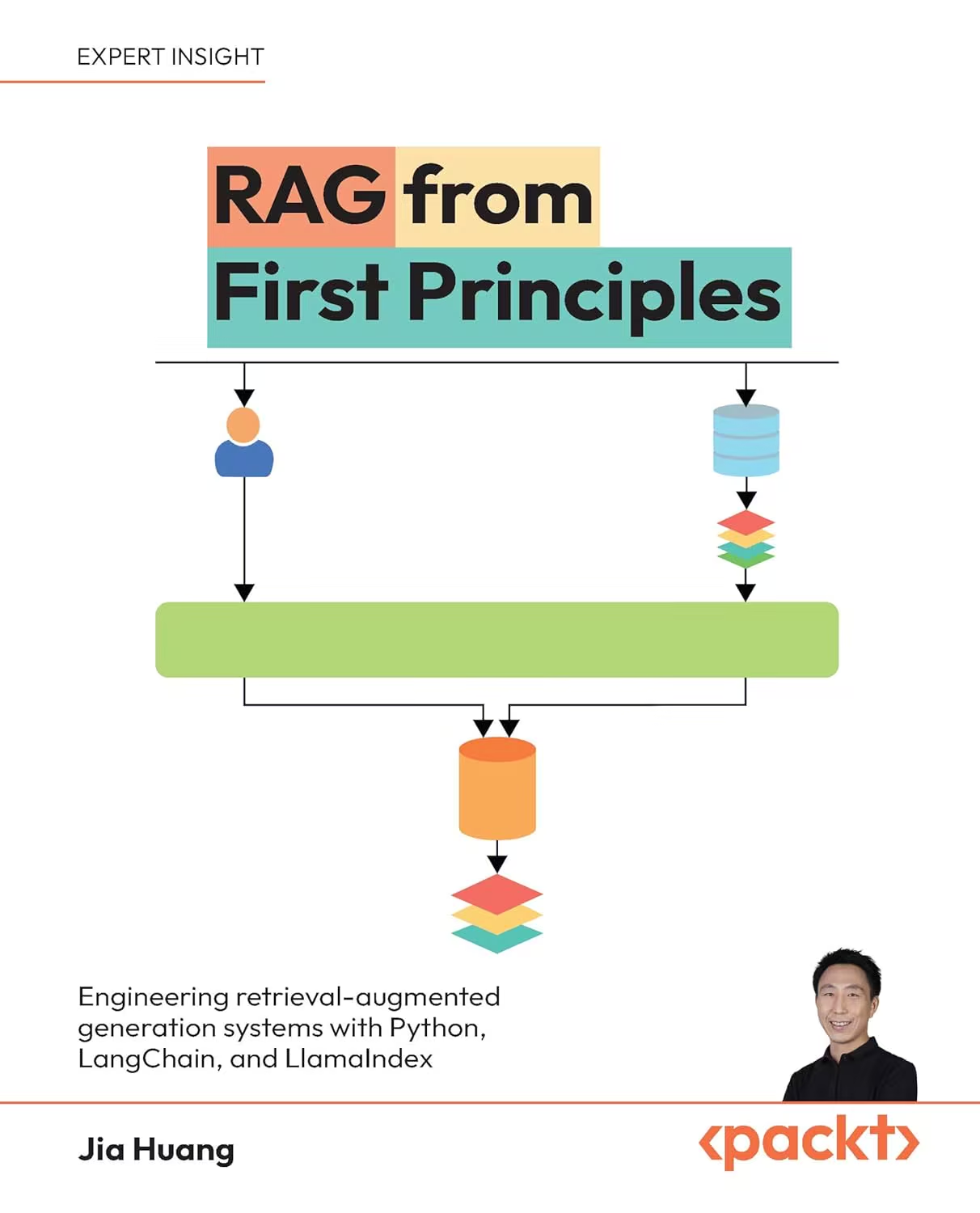
English | 2026 | ISBN: 1835888666 | 628 pages | True EPUB | 44.19 MB
A rigorous, code-first guide to RAG engineering by a bestselling AI author. Master data ingestion, chunking, embeddings, vector storage, hybrid retrieval, reranking, and evaluation from the ground up.
Free with your book: DRM-free PDF version + access to Packt's next-gen Reader*
Key Features
Engineer RAG systems layer by layer, from ingestion to evaluation
Master hybrid retrieval, reranking, and index optimization strategies
Learn through a dialogue-driven, code-first teaching style used by 10,000+ of students
Book Description
Most developers can spin up a RAG pipeline in an afternoon using LangChain or LlamaIndex. Far fewer understand why retrieval fails or how to fix it. This book is for those who want to go deeper.
RAG From First Principles dismantles the retrieval-augmented generation stack layer by layer, explaining how documents are ingested and parsed, why chunking strategy directly impacts answer quality, how embedding models encode meaning, what happens inside a vector database, and how sparse and dense retrieval interact in a hybrid system. Written by Jia Huang, a research engineer and bestselling AI author, it brings both research depth and production experience to one of AI's most critical engineering disciplines.
Structured as a progressive dialogue between a seasoned engineer and two students, the book surfaces the questions practitioners actually ask. Each chapter builds on the last, covering topics from data import and chunking to embedding selection, index design, hybrid search, and post-retrieval processing, before moving on to response generation, evaluation, and advanced paradigms including GraphRAG, Agentic RAG, and Modular RAG.
By the end, you'll have the architectural understanding to optimize, debug, and extend your RAG systems with confidence.
*Email sign-up and proof of purchase required
What you will learn
Parse and ingest diverse document types like PDFs, tables, images, web pages, and structured data
Apply the right chunking strategy for your content type and retrieval goals
Select, compare, and fine-tune embedding models for your domain
Design vector indexes and choose the right similarity metrics for production use
Improve result quality with reranking methods including RRF, cross-encoders, and ColBERT
Integrate retrieval results into generation pipelines using prompt engineering and Self-RAG
Who this book is for
This book is for AI engineers, ML practitioners, and software developers building LLM-powered applications who want a deeper understanding of how retrieval actually works, not just how to call a framework. It is ideal for readers who have built a basic RAG pipeline and now want architectural clarity, optimization strategies.
Technical leads and architects designing production AI systems will find its systematic treatment of indexing, hybrid search, reranking, and evaluation particularly valuable. Familiarity with Python and foundational LLM concepts is assumed.
Quick check before we show the links
Helps us keep automated scrapers from hammering the filehosts.