Math and Magic [pdf]
This post was published 6 years ago. Download links are most likely obsolete. If that's the case, try asking the uploader to re-upload.
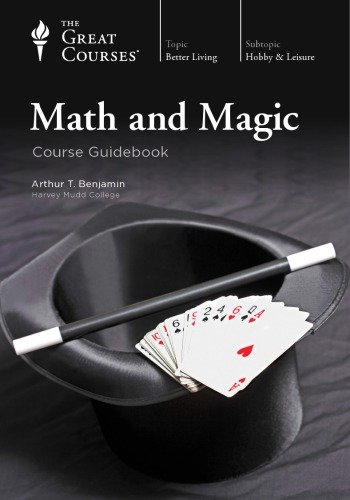
2018 | ISBN: n/a | English | 144 pages | PDF | 20 MB
Try this: Arrange an ordinary deck of cards so that the colors alternate red-black, red-black, all the way through. Now have someone cut the deck as many times as they like. Deal off a stack of cards, one card at a time, that roughly divides the pack in two. Invite someone to shuffle the two stacks together. Then deal cards from the top in pairs. Your audience will be astonished that every pair has a red card and a black card. How can that be?
Nothing can amaze quite like an expertly-executed magic trick. Ideally, only the magician knows how truly simple the deception is. After watching Math and Magic, you will know that this trick and its many variants rely on a remarkable property of patterned sequences called Gilbreath’s principle—named after an amateur magician who was also a mathematician. Magic is full of such wonders, as you discover in these 12 illuminating half-hour lessons presented by one of The Great Course’s most popular lecturers: award-winning Professor of Mathematics Arthur T. Benjamin of Harvey Mudd College, who is himself a professional magician.
Renowned in TED Talks, The Colbert Report, and other popular media as a “mathemagician,” Professor Benjamin teaches you the techniques and secrets behind dozens of great math-based tricks. Even if you are a numerical novice, you will look like a prodigy after mastering these math-inspired showpieces, which require no skills beyond basic algebra—and a bit of showmanship.
Learn the Fundamentals of the Magician’s Art
While magicians supposedly never reveal their tricks, when you learn the mathematical foundations behind how they work, you’re opening your eyes to one of the most fascinating and rewarding features of their craft and it gives you a crucial advantage in a number of areas, including:
• Tricks are easier to remember if you understand how they work.
• Knowing the “why” of a trick is the gateway to new effects as well as novel variations of the original.
• Mathematical magic stimulates problem-solving skills, such as rapid mental calculation.
• Magic can lead young people to fall in love with math—as happened with many professional mathematicians when they were young.
Quick check before we show the links
Helps us keep automated scrapers from hammering the filehosts.